

August 4, 2026
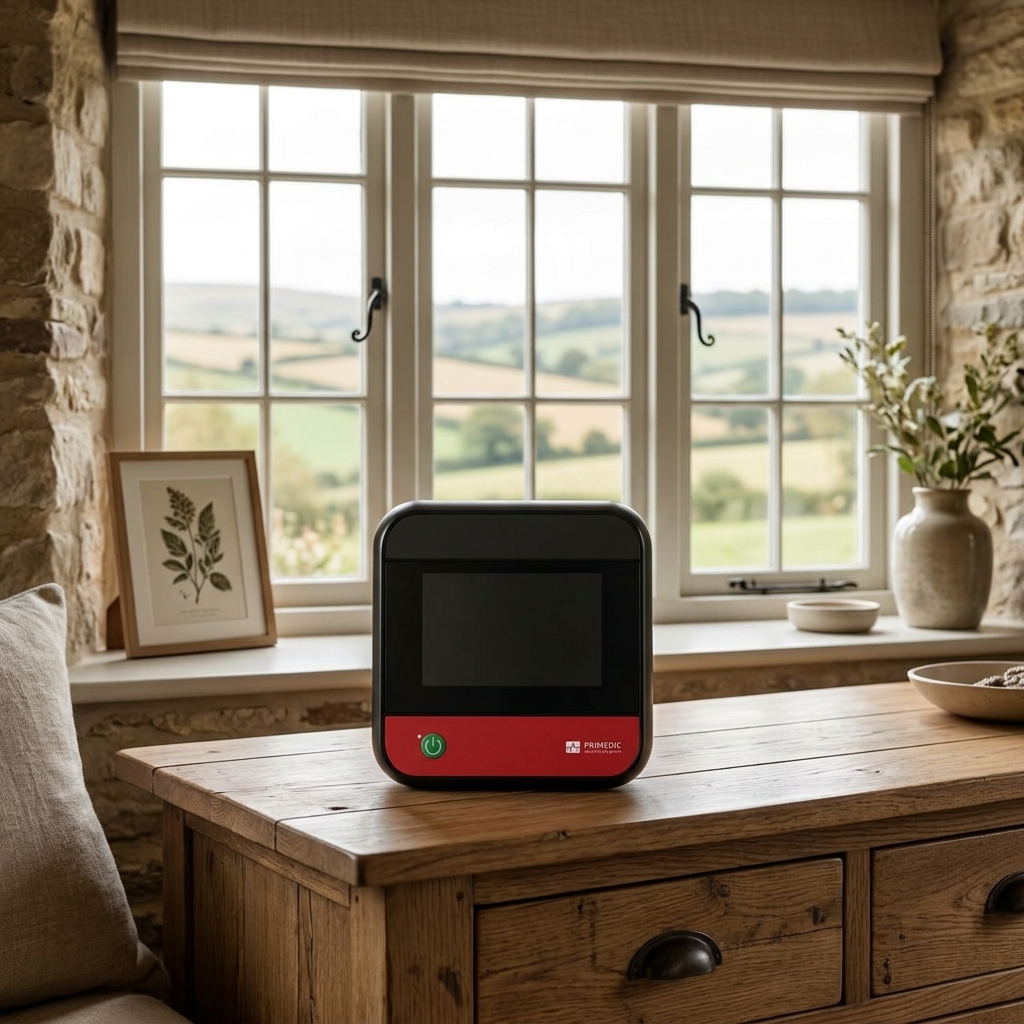
If you've ever watched a medical drama, you've seen the scene: a patient flatlines, a doctor grabs two paddles, shouts "clear!", and the body jolts upward as the heart springs back to life. It's dramatic television, and almost completely wrong.
It's worth knowing why, especially if there's a defibrillator installed in your own home. You may already know the basics: it's there in case of sudden cardiac arrest, and it could make the difference between life and death for someone you love. But what does it actually do when it's switched on and the pads are attached?
Understanding this isn't just interesting, it's reassuring. Knowing exactly how your device works, and what to expect if you ever need it, can make a genuinely frightening moment feel a little more manageable.
Your heart isn't just a muscle. It's an electrical system. A small cluster of cells called the sinoatrial node acts as a natural pacemaker, sending out regular signals that tell the heart when to contract. That's what keeps a heartbeat steady and rhythmic.
In sudden cardiac arrest, that electrical system can go badly wrong. Instead of firing in an organised pattern, the signals become chaotic. The most common cause is ventricular fibrillation, where the heart's lower chambers quiver rapidly and uselessly instead of pumping blood. The heart is technically "active," but it isn't moving blood to the brain and body, which is why the person collapses and stops breathing normally.
Here's the part that surprises most people: a defibrillator doesn't restart a stopped heart. What it does is deliver a brief, controlled shock that momentarily stops all the heart's electrical activity at once, essentially hitting reset. That pause gives the heart's natural pacemaker a chance to take back over and re-establish a normal, organised rhythm.
It's a bit like restarting a computer that's frozen rather than jump-starting a dead battery. The system isn't dead, it's stuck, and the shock clears that state so it can start again properly.
This is also why your defibrillator's built-in rhythm analysis matters so much. The device only delivers a shock if it detects a rhythm that will actually respond to one. If the heart has stopped altogether, a flatline, as in that TV scene, a shock won't help at all, which is exactly the moment those dramas get wrong. What's needed there is CPR. This is why AEDs are designed to guide you through both: analysing the rhythm and prompting CPR in between shocks if needed.
This is the reassuring part. Modern AEDs, including the one installed in your home, are built for people with no medical background. Once switched on, the device talks you through every step, analyses the heart rhythm automatically, and will only allow a shock if one is genuinely needed. You can't accidentally shock someone who doesn't need it. Your job is simply to follow the prompts, call 999, and let the device guide the process alongside CPR.
For someone in cardiac arrest caused by a shockable rhythm, every minute without defibrillation reduces the chances of survival. This is precisely why having a defibrillator in the home matters so much: around 80% of out-of-hospital cardiac arrests happen in the home, not in public places. The person most likely to witness a cardiac arrest isn't a paramedic or a stranger in a shopping centre. It's a partner, a parent, a child, or a friend, in an ordinary room, on an ordinary day.
That's the gap a home defibrillator closes. Public access defibrillators save lives, but they can't help if the emergency happens behind a closed front door, miles from the nearest cabinet. Having one at home, checked, monitored, and ready, means help doesn't have to wait for an ambulance to arrive.
A defibrillator doesn't jolt a stopped heart back to life. It interrupts a dangerously chaotic rhythm so the heart can reset itself into a normal pattern, and it does this safely and automatically, without requiring any medical training. Combined with CPR and a fast call to 999, it gives someone in your home the best possible chance of survival, which is exactly why having one ready, monitored, and rescue-ready matters so much.
Owning a defibrillator is only half the job. It has to be ready the moment it's needed, with working pads and a charged battery, and that's not something most households have time to check on manually. Home Defib takes that off your plate, quietly monitoring your device in the background and reaching out directly if anything ever needs attention. Get in touch to find out how simple, calm protection for your home can work for you.